Affiliate Disclosure: This post contains affiliate links. When you click through and make a purchase, we may earn a small commission at no additional cost to you. This helps support our blog and allows us to continue providing helpful content. Thank you for your support!
Note on Pricing: All prices in this guide are listed in Canadian Dollars (CAD). Prices may vary based on retailer, sales, and promotions. We recommend checking current prices on Amazon.ca, Best Buy Canada, and Apple.ca for the best deals.
Introduction: The Ultimate Smartwatch Showdown
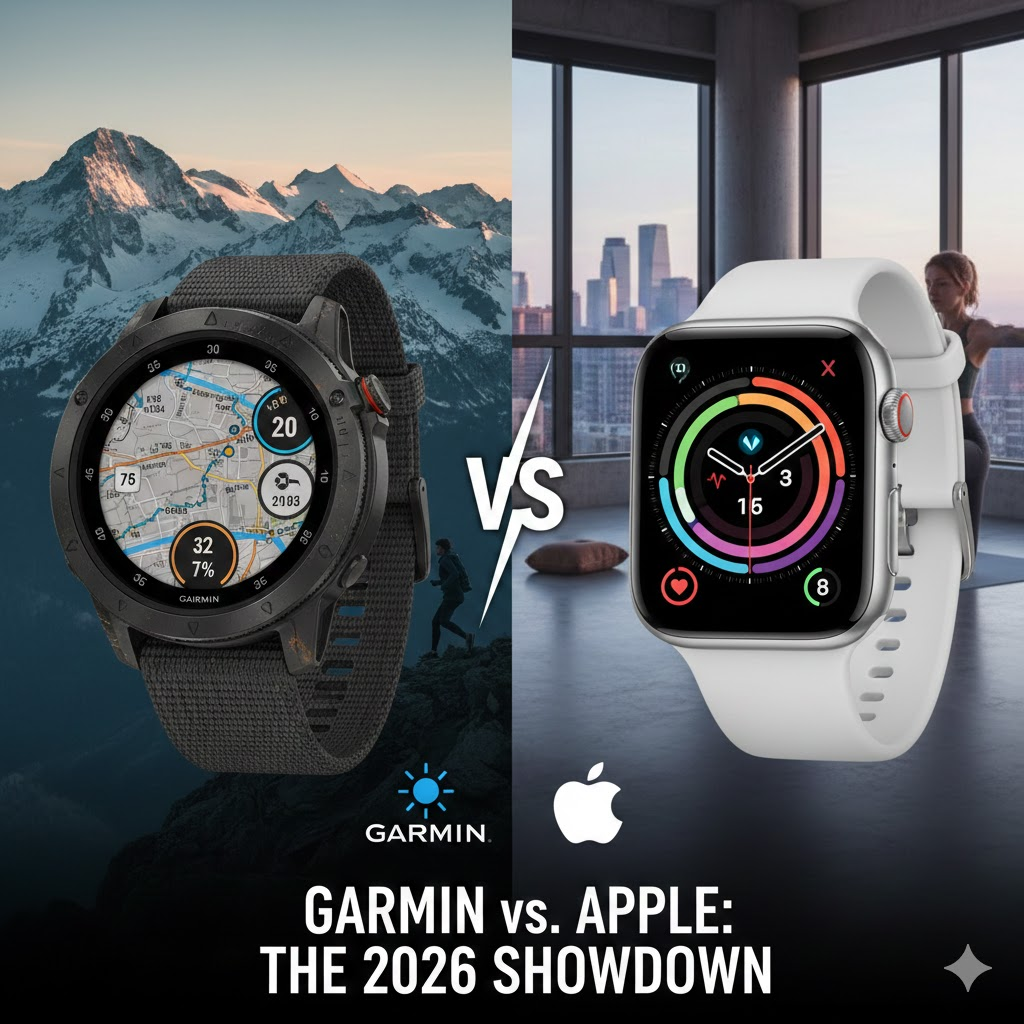
Choosing between a Garmin watch and an Apple Watch isn’t just about picking a fitness tracker—it’s about deciding what kind of technology will sit on your wrist every single day for years to come. Indeed, these two brands represent fundamentally different philosophies: Garmin builds fitness trackers with smartwatch features, while Apple creates smartwatches with fitness tracking capabilities.
This distinction matters more than you might think. In fact, your choice will impact everything from how often you charge your device to what activities you can track. Furthermore, it affects how you interact with your phone, and whether your watch will still be functional after a week-long backcountry hiking trip.
What You’ll Learn in This Guide
In this comprehensive 2026 guide, we’ll break down every important factor to help you make the right decision. Whether you’re a serious athlete training for your next marathon, a casual fitness enthusiast trying to stay healthy, or someone who simply wants the best smartwatch technology, we’ll show you which option truly fits your lifestyle.
Quick Comparison: Garmin vs Apple Watch at a Glance
When to Choose Garmin:
✅ You prioritize multi-day battery life (weeks, not hours)
✅ Serious training metrics and performance analytics matter
✅ You participate in outdoor adventures (hiking, trail running, cycling)
✅ You use an Android phone or switch phones frequently
✅ You want rugged durability and solar charging options
✅ GPS accuracy is critical for your activities
When to Choose Apple Watch:
✅ You’re deeply invested in the Apple ecosystem (iPhone, AirPods, MacBook)
✅ Smartwatch features trump specialized fitness tracking
✅ You value seamless app integration and third-party support
✅ Taking calls and replying to messages from your wrist is essential
✅ You don’t mind daily charging in exchange for advanced features
✅ Health monitoring (ECG, blood oxygen, fall detection) is a priority
Detailed Comparison: Breaking Down the Key Differences
1. Battery Life: The Deal-Breaker for Many
This is often the single most important factor when choosing between these watches.
Apple Watch Battery Life:
- Apple Watch Series 11: Up to 18-24 hours (requires daily charging)
- Apple Watch SE 3: Up to 18 hours (daily charging required)
- Apple Watch Ultra 3: Up to 42 hours normal use, 72 hours low power mode
- GPS Tracking: 10-14 hours for intensive workouts
Even the Ultra 3, Apple’s most rugged model, requires charging every 1-2 days with typical use. Consequently, if you track sleep at night and exercise during the day, you’ll need to find time to charge—usually while showering or working at a desk.
Garmin Battery Life:
- Forerunner 165 (entry-level): 11 days smartwatch, 19 hours GPS
- Forerunner 570 (mid-range): 10 days smartwatch, 19 hours GPS
- Venu 4 (lifestyle): 14 days smartwatch
- Fenix 8 Pro (premium): 27 days smartwatch, 95 hours GPS
- Enduro 3 (ultra-endurance): 36 days smartwatch, 200+ hours GPS
- Instinct 3 Solar: Unlimited battery with sufficient sunlight
Real-World Impact:
One user who switched from Apple Watch to Garmin shared: “I used to have to charge my Apple Watch every single night. During a backpacking trip in the Grand Canyon, I had to plan charging stops or risk losing all tracking. In contrast, with my Garmin Fenix, I’ve gone 5 days without charging even while doing daily activities.”
Winner: Garmin dominates battery life in every category. Unless you’re fine with daily charging, Garmin is clearly the better choice.
👉Shop Garmin Watches on Amazon
2. Fitness Tracking & Training Features
Both brands excel at fitness tracking, however, they approach it very differently.
Garmin’s Fitness Philosophy:
Garmin watches are designed by and for athletes. Furthermore, every feature exists to make you a better, smarter, more efficient athlete.
Key Garmin Fitness Features:
- Training Readiness: Tells you if your body is ready for intense workouts based on sleep, HRV, stress, and recovery
- Training Load & Status: Prevents overtraining by monitoring cumulative training stress
- VO2 Max Tracking: Auto-detects your maximum heart rate and provides accurate cardiovascular fitness estimates
- Race Predictions: Estimates finish times for 5K, 10K, half marathon, and marathon based on current fitness
- Running Dynamics: Detailed metrics like cadence, vertical oscillation, ground contact time (requires chest strap for full data)
- Performance Condition: Real-time analysis during runs showing if you’re performing above or below your fitness level
- Body Battery: Energy monitoring that helps you understand when to push hard and when to rest
- Heat & Altitude Acclimation: Tracks how your body adapts to environmental conditions
- Multi-Sport Modes: 30+ activity profiles with sport-specific metrics
Apple Watch Fitness Features:
Apple’s approach prioritizes accessibility and motivation over deep analytics. Additionally, the interface is beautiful and encouraging, though less detailed than Garmin’s offerings.
Key Apple Watch Fitness Features:
- Activity Rings: Simple, motivating visualization of Move, Exercise, and Stand goals
- Workout App: Tracks 100+ workout types with basic metrics
- Heart Rate Zones: Shows effort levels during exercise
- Running Power: New metric for runners (similar to cycling power)
- Swimming Tracking: Automatic stroke detection and lap counting
- Apple Fitness+: Integrated workout classes (subscription required)
- Workout Sharing: Compete and share achievements with friends
- Personalized Metrics: Custom heart rate zones and activity goals
- Recovery & Load: Basic training load indicators (new in watchOS 11)
Data Depth Comparison:
After a 10K run, here’s what each watch tells you:
Garmin: Distance, pace, elevation, heart rate zones, VO2 max estimate, training effect (aerobic/anaerobic), recovery time needed, race time predictions, performance condition, running dynamics (with chest strap), lactate threshold, detailed split analysis, and how this run impacts your overall training load.
Apple Watch: Distance, pace, elevation gain, average heart rate, heart rate zones, calories burned, route map, splits, and whether you achieved a personal best.
Winner: Garmin for serious athletes; Apple Watch for general fitness enthusiasts. Specifically, if training analytics matter, Garmin is unmatched. Conversely, if you want simple, motivating tracking, Apple Watch excels.
3. Smartwatch Features & Daily Usability
This is where Apple Watch truly shines. In fact, it outperforms Garmin significantly in this category.
Apple Watch Smart Features:
The Apple Watch is essentially a miniature iPhone on your wrist.
What Apple Watch Does Better:
- App Ecosystem: Thousands of third-party apps (Spotify, WhatsApp, Uber, banking apps, games)
- Phone Calls: Take calls directly from your watch with built-in speaker and microphone
- Message Replies: Full keyboard, voice dictation, and preset responses
- Siri Integration: Voice commands for everything (“Hey Siri, set a timer for 15 minutes”)
- Apple Pay: Contactless payments work everywhere that accepts tap-to-pay
- Camera Control: Use your watch as a remote viewfinder and shutter for iPhone photos
- Maps Navigation: Turn-by-turn directions with haptic feedback on your wrist
- Music Streaming: Native Spotify, Apple Music, and podcast apps with offline storage
- Find My Integration: Locate your iPhone, AirPods, or other Apple devices
- Seamless Ecosystem: Unlocks Mac, controls HomePods, interfaces with iPad
Garmin Smart Features:
Garmin watches include smartwatch basics but lack the deep integration Apple offers. Nevertheless, they provide essential functionality for most users.
What Garmin Offers:
- Smartphone Notifications: View texts, calls, emails, and app alerts (limited reply capabilities)
- Garmin Pay: Contactless payments (not as widely supported as Apple Pay)
- Music Storage: Offline Spotify, Amazon Music, Deezer (Apple Music requires workarounds)
- Connect IQ Apps: Third-party apps and watch faces (limited compared to Apple)
- Android & iPhone Compatible: Works with both platforms (huge advantage over Apple Watch)
- Weather Forecasts: Detailed weather data
- Calendar Integration: View appointments and reminders
- Voice Assistance: Limited compared to Siri
Fenix 8 Pro Note: The latest Fenix 8 Pro includes a speaker and microphone for voice commands. Moreover, it has LTE-M connectivity for satellite messaging, thereby narrowing the gap with Apple’s smart features.
Real-World Scenarios:
Scenario 1: You’re at the grocery store with dirty hands while cooking.
- With Apple Watch: “Hey Siri, add eggs to my shopping list.” Done.
- With Garmin: Pull out your phone to update your list.
Scenario 2: You receive an urgent text while running.
- With Apple Watch: Read it, dictate a voice reply, or send a quick preset response—all from your wrist.
- With Garmin: Read the notification, but you’ll need to finish your run and grab your phone to reply.
Winner: Apple Watch dominates smartwatch functionality. If you want a true wrist computer, Apple wins easily.
4. Health Monitoring & Medical Features
Both watches track health metrics, however, Apple Watch includes FDA-cleared medical features that set it apart.
Apple Watch Health Features:
Apple has invested heavily in health monitoring with FDA clearances for several features. As a result, it offers medical-grade capabilities.
Advanced Health Monitoring:
- ECG (Electrocardiogram): Medical-grade heart rhythm analysis that can detect AFib
- Blood Oxygen Monitoring: SpO2 measurements during sleep and on-demand
- High Blood Pressure Detection: NEW in 2026 – monitors for signs of hypertension over 30-day periods
- Fall Detection: Automatically calls emergency services if you take a hard fall
- Crash Detection: Detects severe car accidents and contacts emergency responders
- Sleep Apnea Notifications: Alerts you to possible sleep apnea requiring medical evaluation
- Heart Rate Alerts: Notifies of abnormally high or low heart rates
- Temperature Sensing: Wrist temperature tracking for cycle tracking and illness detection
- Sleep Score: NEW – comprehensive sleep quality analysis
- Vitals App: Tracks key overnight health metrics and alerts to concerning changes
- Noise Monitoring: Warns when ambient noise could damage hearing
- Menstrual Cycle Tracking: Period predictions with retrospective ovulation estimates
Garmin Health Features:
Garmin focuses on wellness and performance rather than medical diagnostics. Instead, it emphasizes athletic recovery and training optimization.
Health & Wellness Tracking:
- Pulse Ox: Blood oxygen saturation monitoring (similar to Apple)
- Body Battery: Proprietary energy monitoring based on stress, sleep, and activity
- Stress Tracking: All-day stress level monitoring with relaxation breathing exercises
- Advanced Sleep Monitoring: Sleep stages, sleep score, and personalized insights
- HRV Status: Heart rate variability tracking for recovery insights
- Fitness Age: Compares your fitness level to average for your age
- Health Snapshot: 2-minute session capturing key health stats
- Respiration Rate: Breathing rate throughout the day and during sleep
- Hydration Tracking: Log water intake (Venu series)
- Women’s Health: Menstrual cycle and pregnancy tracking
The Medical Device Difference:
Apple Watch has FDA clearance for its ECG and irregular rhythm notifications. This means it meets medical device standards for detecting atrial fibrillation. Moreover, several users have credited their Apple Watch with detecting serious heart conditions that led to life-saving medical intervention.
In contrast, Garmin watches provide valuable health insights but don’t have the same medical device certifications. Therefore, they’re wellness tools, not diagnostic devices.
Winner: Apple Watch for medical-grade health monitoring. Garmin for holistic wellness and athletic recovery tracking.
5. GPS Accuracy & Navigation
This feature is critical for runners, cyclists, and outdoor adventurers. Indeed, GPS performance can make or break your outdoor experience.
Garmin GPS Technology:
GPS is Garmin’s heritage—they’ve been building GPS devices since 1989. Consequently, their expertise in this area is unmatched.
Garmin GPS Advantages:
- Multi-Band GNSS: Premium models use multiple satellite systems (GPS, GLONASS, Galileo) on multiple frequencies for incredible accuracy
- SatIQ Technology: Automatically switches between single and multi-band GPS to optimize battery life
- Pre-Loaded Maps: Full topographic maps on Fenix and Forerunner 965/970
- Turn-by-Turn Navigation: On-watch directions for complex routes
- ClimbPro: Shows remaining ascent on climbs during trail runs and hikes
- TracBack Routing: Navigate back to your starting point
- Breadcrumb Trails: Follow previously recorded routes
- Offline Maps: All navigation works without phone connection
- Ski Resort Maps: Pre-loaded trail maps for 2,000+ ski resorts
- Golf Courses: 43,000+ courses with distances to greens and hazards
Apple Watch GPS:
Apple Watch has improved GPS significantly in recent years. However, it still trails Garmin for outdoor accuracy in challenging conditions.
Apple Watch GPS Features:
- Dual-Frequency GPS: Ultra 3 model includes multi-band GPS for better accuracy
- Route Tracking: Records your path during workouts
- Compass & Waypoints: Mark locations and navigate to them (Ultra models)
- Backtrack: Navigate back to start using breadcrumb trail (Ultra models)
- Maps Integration: Turn-by-turn directions via iPhone integration
- Elevation Tracking: Barometric altimeter measures elevation gain
Real-World Accuracy Testing:
Multiple runners testing Garmin Forerunner vs Apple Watch on the same routes consistently find the following results:
- Open areas: Both watches perform similarly
- Urban canyons (tall buildings): Garmin multi-band GPS maintains accuracy; Apple Watch can lose signal or show erratic tracking
- Dense forest trails: Garmin stays more consistent
- Route complexity: Garmin handles switchbacks and tight turns better
Winner: Garmin for GPS accuracy and outdoor navigation. While Apple Watch is improving, it can’t match Garmin’s dedicated GPS technology, especially in challenging environments.
6. Durability & Build Quality
Apple Watch Construction:
Apple Watches are beautifully designed. However, they prioritize aesthetics over ruggedness.
Build Materials:
- Aluminum Models: Lightweight but prone to scratches
- Stainless Steel: More durable, heavier, polished finish
- Titanium (Ultra 3): Lightweight, strong, scratch-resistant
- Sapphire Crystal: Premium models use scratch-resistant glass
- Water Resistance: 50 meters (Series/SE), 100 meters (Ultra 3 – suitable for diving)
Durability Concerns:
- Touchscreen can crack from impacts
- No bezel protection around the screen
- Sleek design leaves glass exposed
- Not designed for extreme outdoor abuse
Garmin Construction:
Garmin watches are built for harsh outdoor conditions. In fact, they’re designed to survive environments that would destroy most smartwatches.
Build Materials:
- Fiber-Reinforced Polymer: Lightweight, durable standard cases
- Stainless Steel Bezels: Protect screen from impacts
- Titanium Cases: Premium models offer exceptional strength-to-weight ratio
- Sapphire Crystal: Available on mid-range and higher models
- Corning Gorilla Glass: Entry-level models use chemically strengthened glass
- Water Resistance: 50-100 meters standard; Fenix 8 Pro rated to 40m for diving
- Military Standard (MIL-STD-810): Many models tested for thermal, shock, and water resistance
Durability Advantages:
- Button controls work when wet, with gloves, or in cold weather
- Raised bezels protect screens from impacts
- Built to withstand drops, bumps, and extreme conditions
- Proven durability in marathons, Ironman races, and ultramarathons
One Garmin user reported: “I’ve used my Fenix for 2 years through countless hikes, workouts, and travel. The screen is still scratch-free despite taking some serious abuse. It’s genuinely built for the outdoors.”
Winner: Garmin for durability. While Apple Watch is well-made, it’s not designed for extreme conditions. Therefore, if you’re rough on watches, choose Garmin.
7. Display Quality & Visibility
Apple Watch Displays:
Apple’s Retina displays are gorgeous—among the best screens on any smartwatch. In particular, they excel at indoor viewing and media consumption.
Display Technology:
- LTPO OLED/AMOLED: Vibrant colors, deep blacks, excellent contrast
- Always-On Display: Shows time and complications without raising wrist
- Bright Screen: Up to 2,000 nits brightness for outdoor visibility
- Touchscreen: Smooth, responsive multi-touch interface
- Large Sizes: 42mm, 46mm (Series 11), 49mm (Ultra 3)
Advantages: Beautiful indoors, great for viewing photos and notifications, smooth animations
Drawbacks: Can be hard to see in direct sunlight, battery drain from bright displays
Garmin Displays:
Garmin offers two display technologies depending on model. Each has distinct advantages for different use cases.
MIP (Memory-in-Pixel) Displays:
- Always-on, ultra-low power consumption
- Exceptional visibility in direct sunlight (actually gets easier to read)
- Muted colors, less impressive indoors
- Found on: Instinct 3 Solar, Enduro 3, Fenix 8 Solar
AMOLED Displays:
- Vibrant colors, high contrast like Apple Watch
- Touchscreen capable
- Shorter battery life than MIP
- Found on: Venu 4, Forerunner 265/570/970, Fenix 8 AMOLED
Winner: Apple Watch for indoor display quality. Garmin MIP for outdoor visibility. Notably, Garmin AMOLED models offer a middle ground between these extremes.
8. Pricing & Value
Apple Watch Pricing (CAD):
| Model | Price | Best For |
|---|---|---|
| Apple Watch SE 3 | $329 – $429 | Budget-conscious iPhone users |
| Apple Watch Series 11 | $549 – $849 | Most iPhone users |
| Apple Watch Ultra 3 | $1,079 | Extreme sports, long battery needs |
Garmin Pricing (CAD):
| Model | Price | Best For |
|---|---|---|
| Forerunner 165 | $437.74 | Entry-level runners |
| Instinct 3 | $579.98 | Budget outdoor enthusiasts |
| Venu 4 | $769.99 | Lifestyle fitness tracking |
| Forerunner 570 | $796.81 | Serious runners |
| Forerunner 970 | $1,099.98 | Elite runners/triathletes |
| Enduro 3 | $1,319.99 | Ultra-endurance athletes |
| Fenix 8 Pro | $1,819.99 | Premium multi-sport/adventure |
👉Shop Garmin Watches on Amazon
Value Considerations:
Apple Watch: Requires iPhone (adds to total cost if you don’t have one). AppleCare+ recommended ($109-$179 CAD). Additionally, many features require subscriptions (Apple Fitness+, cellular plan).
Garmin: Works with any phone and includes all features without subscriptions. Furthermore, it offers longer lifespan due to exceptional battery life and durability. Moreover, Garmin watches tend to have better resale value over time.
Winner: Tie. Apple Watch SE 3 offers incredible value for iPhone users. Meanwhile, Garmin provides better long-term value for athletes due to no subscription costs and longer device lifespan.
9. App Ecosystem & Third-Party Integration
Apple Watch:
The App Store for Apple Watch includes thousands of apps. As a result, it offers unmatched versatility for daily tasks.
Popular Apple Watch Apps:
- Spotify, YouTube Music, Apple Music (full streaming)
- WhatsApp, Telegram, Messenger (full messaging)
- Banking apps with transaction alerts
- Uber, Lyft for ride-hailing
- Carrot Weather, Dark Sky alternatives
- Games and entertainment apps
- Productivity apps (Todoist, Things, Notion)
Garmin:
Connect IQ store offers apps, watch faces, and data fields. However, the selection is more limited than Apple’s ecosystem.
Garmin App Integration:
- Strava (seamless sync)
- TrainingPeaks (coaching platform integration)
- MyFitnessPal (nutrition tracking)
- Komoot (route planning)
- Spotify, Amazon Music, Deezer (offline music)
- Limited third-party apps compared to Apple
Winner: Apple Watch dominates app selection and third-party integration. In fact, it’s not even close in this category.
10. Platform Compatibility
Apple Watch:
- Only works with iPhone (iPhone 11 or later with iOS 26)
- Requires iCloud account
- Family Setup allows kids without iPhone to use Apple Watch
- No Android support whatsoever
Garmin:
- Works with iPhone AND Android
- Garmin Connect app available on both platforms
- Easy to switch phones without losing data
- True platform independence
Winner: Garmin for platform flexibility. In contrast, Apple Watch locks you into the iOS ecosystem completely.
Head-to-Head: Model Comparisons
Budget Battle: Apple Watch SE 3 vs Garmin Forerunner 165
Apple Watch SE 3 (CAD $329-$429)
✅ Best value Apple Watch
✅ Full smartwatch features
✅ Basic fitness tracking
❌ 18-hour battery life
❌ No ECG or blood oxygen
❌ Aluminum case only
Garmin Forerunner 165 (CAD $437.74)
✅ 11-day battery life
✅ Advanced running metrics
✅ AMOLED display
❌ Basic smart features
❌ No maps
❌ iPhone users lose some functionality
Verdict: Apple Watch SE 3 for iPhone users wanting a smartwatch. Conversely, Forerunner 165 is ideal for dedicated runners.
Mid-Range Matchup: Apple Watch Series 11 vs Garmin Venu 4
Apple Watch Series 11 (CAD $549-$849)
✅ Premium smartwatch experience
✅ ECG and advanced health features
✅ Massive app ecosystem
✅ Beautiful display
❌ Daily charging required
❌ iPhone only
Garmin Venu 4 (CAD $769.99)
✅ 14-day battery life
✅ Comprehensive fitness tracking
✅ Platform independent
✅ Offline music storage
❌ Limited app selection
❌ Can’t reply to messages fully
Verdict: Series 11 for iPhone users prioritizing smart features. On the other hand, Venu 4 suits fitness-focused users who want great battery life.
Premium Showdown: Apple Watch Ultra 3 vs Garmin Fenix 8 Pro
Apple Watch Ultra 3 (CAD $1,079)
✅ 42-hour battery (72 low power)
✅ Satellite emergency messaging
✅ Premium iPhone integration
✅ Cellular calling
✅ Dive computer (100m)
❌ Still requires frequent charging
❌ Limited to iPhone users
Garmin Fenix 8 Pro (CAD $1,819.99)
✅ 27-day battery life
✅ Superior GPS accuracy
✅ Comprehensive mapping
✅ Platform independent
✅ Dive computer (40m)
✅ Solar charging option
❌ Much higher price
❌ Smartwatch features lag Apple
Verdict: Ultra 3 for iPhone users wanting the best Apple experience with improved battery. Alternatively, Fenix 8 Pro is perfect for serious multi-sport athletes and outdoor adventurers.
Making Your Decision: A Simple Framework
Choose Apple Watch If:
- You own an iPhone and plan to keep using iPhones
- Smartwatch functionality is your #1 priority
- You want the best app ecosystem and third-party support
- Daily charging doesn’t bother you (or you charge overnight anyway)
- Health monitoring features like ECG matter to you
- You value style and want a watch that looks good everywhere
- Taking calls and fully interacting with messages is essential
- You’re a casual exerciser, not a competitive athlete
- The Apple ecosystem integration (Mac, AirPods, HomePod) appeals to you
- You want the best overall smartwatch experience
Recommended Models:
- Best Value: Apple Watch SE 3 (CAD $329)
- Best Overall: Apple Watch Series 11 (CAD $549)
- Best for Athletes: Apple Watch Ultra 3 (CAD $1,079)
Choose Garmin If:
- Multi-day battery life is non-negotiable
- You’re a serious athlete who needs advanced training analytics
- You participate in outdoor adventures (trail running, hiking, cycling)
- GPS accuracy is critical for your activities
- You use Android or like switching between phone brands
- You want a watch that survives extreme conditions
- You prefer physical buttons over touchscreens
- Solar charging appeals to you
- You don’t need extensive smartwatch features
- You want a specialized fitness tool, not a general-purpose device
Recommended Models:
- Best Value: Garmin Forerunner 165 (CAD $437)
- Best for Runners: Garmin Forerunner 570 (CAD $797)
- Best for Adventure: Garmin Fenix 8 Pro (CAD $1,820)
- Best Battery: Garmin Enduro 3 (CAD $1,320)
👉Shop Garmin Watches on Amazon
Frequently Asked Questions
Can I use Garmin with iPhone?
Yes! All Garmin watches work perfectly with iPhone through the Garmin Connect app. You’ll get notifications, activity syncing, and access to all features. However, the only limitation is that you can’t reply to messages directly from the watch on iPhone. In contrast, Android users can send message replies.
Can I use Apple Watch without iPhone?
No. Apple Watch requires an iPhone for initial setup and ongoing functionality. While cellular models can make calls and access some features independently, you still need an iPhone to use Apple Watch properly.
Which watch is better for running?
Garmin is definitively better for serious runners. The advanced metrics (training load, VO2 max, race predictions, running dynamics), superior GPS accuracy, and multi-day battery life make it the choice of marathon and ultramarathon runners worldwide.
In contrast, Apple Watch is fine for recreational runners who just want basic tracking and motivation.
Can I shower with these watches?
Yes, both are water-resistant and shower-safe:
- Apple Watch: 50m water resistance (Series/SE), 100m (Ultra) – swim and shower safe
- Garmin: 50-100m water resistance across the lineup – swim and shower safe
Furthermore, the Fenix 8 Pro is even rated as a dive computer to 40 meters.
Which has better sleep tracking?
Garmin provides more detailed sleep analysis with sleep score, sleep stages, and personalized recommendations. Furthermore, the multi-day battery means you never skip sleep tracking due to charging needs.
Apple Watch recently added sleep scores and is improving rapidly. However, the daily charging requirement can interrupt consistent sleep tracking.
Do I need a subscription for either watch?
Apple Watch: No subscription required for core features. Optional subscriptions include:
- Apple Fitness+ ($12.99/month CAD)
- Cellular plan ($5-15/month through your carrier)
- Music streaming services
Garmin: No subscriptions required at all. All features included. Music streaming requires separate Spotify/Amazon Music subscription.
Can I download music offline?
Yes, both support offline music storage:
- Apple Watch: Apple Music, Spotify, Amazon Music
- Garmin: Spotify, Amazon Music, Deezer (Apple Music requires manual MP3 transfer)
Which watch is more accurate for heart rate?
Both use optical heart rate sensors that perform similarly during normal activities. For maximum accuracy during intense workouts, both support connecting to chest strap heart rate monitors.
Garmin tends to be slightly more accurate during high-intensity interval training due to more mature algorithms. However, the difference is marginal for most users.
Can I track cycling/swimming/golf?
Yes, both excel at multi-sport tracking:
- Apple Watch: Great for basic tracking of all sports
- Garmin: Superior cycling metrics, stroke analysis for swimming, and dedicated golf features with 43,000+ course maps
Which is better for hiking?
Garmin dominates hiking and outdoor navigation. Specifically, it offers:
- Pre-loaded topographic maps
- TracBack routing to return to start
- Longer battery life for multi-day trips
- Solar charging options
- Superior GPS accuracy in forests and canyons
- Altimeter and barometer for elevation tracking
While Apple Watch Ultra is improving with Backtrack and waypoint features, it can’t match Garmin’s comprehensive mapping and battery life capabilities.
The Verdict: There’s No Universal Winner
After analyzing every aspect, here’s the truth: both watches are excellent at what they’re designed to do. However, they serve different purposes.
Apple Watch is the better smartwatch.
If you own an iPhone and want the most capable, feature-rich smartwatch available, nothing beats Apple Watch. The ecosystem integration, app selection, health features, and overall user experience are unmatched. Indeed, the Series 11 is the best general-purpose smartwatch money can buy.
For iPhone users who aren’t serious athletes, Apple Watch is clearly the obvious choice.
Garmin is the better fitness tracker.
If athletic performance, training analytics, multi-day adventures, and specialized sports tracking matter to you, Garmin is in a league of its own. Moreover, the battery life alone is game-changing for active people. Professional athletes and serious amateurs overwhelmingly choose Garmin for a reason.
For dedicated athletes and outdoor enthusiasts, Garmin provides tools Apple Watch simply cannot match.
Final Recommendations by User Type
Casual iPhone User (Not Athletic):
→ Apple Watch SE 3 (CAD $329) – Best value, all essential features
Fitness-Focused iPhone User:
→ Apple Watch Series 11 (CAD $549) – Perfect balance of smart and fitness features
iPhone User Who Exercises Daily:
→ Garmin Venu 4 (CAD $770) – Better fitness tracking, 14-day battery, still works with iPhone
Beginner Runner:
→ Garmin Forerunner 165 (CAD $438) – Everything you need to grow as a runner
Serious Runner/Triathlete:
→ Garmin Forerunner 970 (CAD $1,100) – Professional-grade running metrics
Outdoor Adventurer:
→ Garmin Fenix 8 Pro (CAD $1,820) – The ultimate adventure watch
Ultra-Endurance Athlete:
→ Garmin Enduro 3 (CAD $1,320) – Unbeatable battery for multi-day events
iPhone User Who Does Everything:
→ Apple Watch Ultra 3 (CAD $1,079) – Best Apple experience with improved battery
Android User:
→ Any Garmin – Apple Watch won’t work with your phone
Conclusion: Make the Choice That Fits Your Life
The question isn’t “Which is better?”—it’s “Which is better for you?” Ultimately, your personal needs should guide this decision.
If you picked up your phone right now and saw it was an iPhone, and you care more about receiving texts than analyzing your VO2 max, buy an Apple Watch. You’ll love it.
On the other hand, if you just registered for your first marathon, or you’re planning a week-long backpacking trip, or you’re tired of daily charging, buy a Garmin. You’ll wonder why you waited.
Both companies make outstanding products. Ultimately, your lifestyle, your phone, and your fitness goals will tell you which is right. Therefore, take time to consider what matters most to you before making this important decision.
Choose wisely, and enjoy your new watch!
Related Articles:
Best Garmin Watches in 2026: Your Complete Guide to Finding the Perfect GPS Smartwatch
Leave a Reply