Introduction
Smart glasses have quietly crossed the line from novelty gadget to genuinely useful daily wearable — and 2026 is the year the category is truly coming of age. Shipments of AR and smart eyewear are projected to grow by nearly 40% this year, driven by two very different visions of what “smart glasses” should actually be.
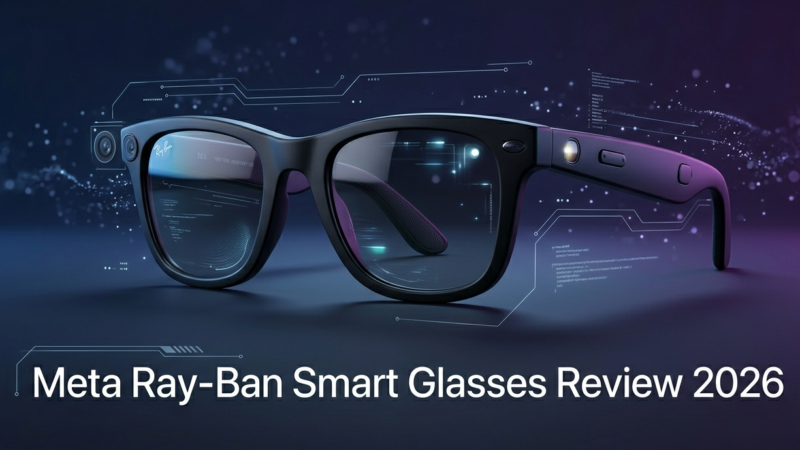
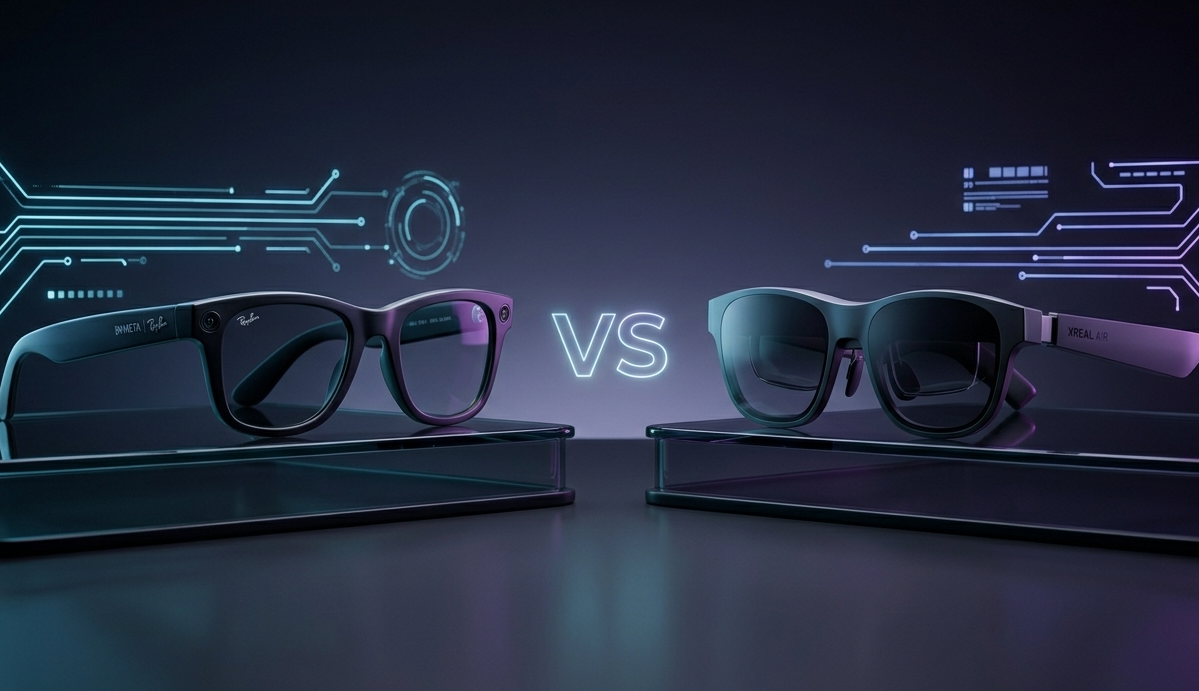
On one side: the Meta Ray-Ban smart glasses, a socially wearable AI companion that looks like a normal pair of sunglasses, listens to your world, and talks back through Meta AI. On the other: the Xreal Air, a wearable display powerhouse that transforms any USB-C device into a personal 201-inch cinema floating in front of your face.
Same category. Completely different use cases. That’s exactly what makes this comparison so interesting.
In this article, we’re putting the Meta Ray-Ban vs Xreal Air head-to-head across every major dimension — design, display tech, camera, audio, AI features, battery life, compatibility, and price — so you can confidently decide which pair belongs on your face.
Quick Comparison Table
| Feature | Meta Ray-Ban Smart Glasses | Xreal Air |
|---|---|---|
| Display Technology | No display (audio/AI only) | Dual Sony Micro-OLED, 1080p, 120Hz |
| Virtual Screen Size | N/A | Up to 201 inches |
| Camera | 12MP ultrawide, 3K video @ 30fps | None |
| Audio | Dual open-ear speakers, 5-mic array | Dual built-in speakers |
| Battery Life | ~4–6 hrs (glasses); 32–48 hrs with case | No onboard battery (draws from device) |
| Weight | 133g | ~79g |
| AI Features | Meta AI (LLaMA 4), voice assistant, live translation | None (display only) |
| Compatibility | iOS & Android (Meta AI app required) | PC, Mac, Android, iOS, Switch, PS5, Xbox |
| Price | ~$299 (standard) / $799 (Display model) | ~$299–$379 |
| Best For | Everyday AI assistant, social use, content capture | Movies, gaming, productivity, AR display |
Meta Ray-Ban Smart Glasses: Overview
Design and Build Quality
The Meta Ray-Ban glasses nail the one thing Google Glass never could: they look completely normal. Built in partnership with EssilorLuxottica, they come in iconic Ray-Ban frames — Wayfarer, Headliner, Skyler — and wear like any premium pair of sunglasses you’d pick up at a boutique. At 133 grams, they’re heavier than a typical frame but not uncomfortably so. You can wear them all day without drawing a second glance, which is arguably their biggest design win.
Prescription lens support is available, making these an actual daily-driver option for people who already need corrective eyewear. The charging case has also been redesigned with Gen 2, offering a sleeker profile while bumping total battery capacity significantly.
Camera Capabilities
The camera is one of the Meta Ray-Ban’s standout features. The 12MP ultrawide lens shoots up to 3K video at 30fps, 1080p at 60fps, and handles portrait-mode stills at over 12 megapixels. There’s a five-microphone array for spatial audio recording, making captured videos feel genuinely immersive rather than flat.
Live-streaming directly to Facebook and Instagram is supported out of the box — a useful feature for content creators who want first-person perspectives without mounting a GoPro to their head.
AI and Smart Features
This is where the Meta Ray-Ban smart glasses genuinely shine in 2026. Powered by Meta AI with LLaMA 4 integration, these glasses act as a persistent, always-on AI assistant. Say “Hey Meta” and you can ask about anything you’re looking at, get live sports scores, request real-time translations in six languages, make calls, send texts, or ask for restaurant recommendations nearby.
The multimodal capability — where Meta AI uses the camera to see what you’re seeing and respond intelligently — is a genuinely impressive use case. Point at a menu in a foreign language and get an instant translation. Walk past a landmark and ask what it is. These aren’t gimmicks; they’re daily quality-of-life features.
For the premium Meta Ray-Ban Display model ($799), a full-color monocular HUD is added to the right lens, with a 600×600 resolution display, 20-degree field of view, and up to 5,000 nits brightness. Gesture control via the included Neural Band (EMG wristband) rounds out the package.
Audio and Voice Assistant
Open-ear dual speakers deliver directional audio that’s surprisingly solid for casual listening and calls. The five-mic system provides high-quality audio recording and reliable voice command pickup even in moderately noisy environments. Continuous audio playback runs around 4–5 hours depending on the model, with up to 5.5 hours of phone calls.
✅ Pros
- Looks like normal Ray-Ban sunglasses — zero stigma
- Meta AI with LLaMA 4 is genuinely useful daily
- Excellent 12MP camera and 3K video
- Live translation in six languages
- Prescription lens support
- Long total battery life with charging case
❌ Cons
- No AR display on standard model (audio-only AI)
- Heavier than regular sunglasses at 133g
- Privacy concerns around always-on camera
- Display model ($799) has limited retail availability
- Requires Meta account and Meta AI app
🎯 Best For
Social media creators, commuters, travelers, and anyone who wants an intelligent daily companion they can wear without looking like a tech person.
Xreal Air: Overview
Display Technology
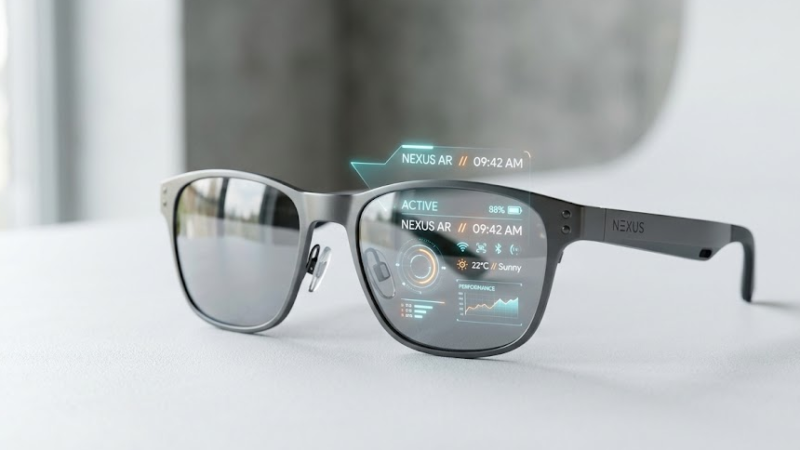
The Xreal Air is a fundamentally different product. There’s no AI, no camera, no voice assistant — what it offers instead is one of the best portable display experiences on the market. Each lens hides a Sony-manufactured Micro-OLED panel running at 1080p resolution with a 120Hz refresh rate. The result is a crisp, fluid virtual screen that can simulate up to a 201-inch display in your field of view, floating like a private cinema screen no matter where you are.
Brightness reaches around 600 nits on the base Air model, which is comfortable indoors and passable in moderately lit environments (though direct sunlight is still challenging). The newer Xreal One and 1S models step up to 700 nits and a 52-degree field of view. Micro-OLED ensures deep blacks and vivid color reproduction that LCD-based alternatives simply can’t match at this form factor.
Media and Entertainment Capabilities
This is where Xreal earns its reputation. Plug it into a laptop via USB-C and your entire screen becomes a massive floating display. Plug it into a Nintendo Switch, Steam Deck, PS5, or Xbox (with appropriate adapters), and you’re gaming on a virtual 200-inch screen from your couch — or your airplane seat. Streaming Netflix, YouTube, or any other app is smooth and immersive in a way that’s hard to appreciate until you’ve experienced it.
The optional Xreal Beam accessory ($109) adds Wi-Fi, battery, and spatial anchoring features, making the virtual screen “float” in a fixed position as you move your head — a significant comfort upgrade for longer sessions. Xreal also has the ability to convert standard 2D video to 3D, which is a surprisingly effective trick for movies.
Comfort and Design
At just 79 grams, the Xreal Air is notably lighter than the Meta Ray-Ban. The design resembles a slightly thicker pair of modern sunglasses, with a matte finish and a good build quality for the price. Three sizes of interchangeable nose pads are included, and a prescription lens insert is available via optical partners.
One trade-off: the Xreal Air has no internal battery, drawing all power from the connected device. On a phone, this drains the host battery at roughly 5% per ten minutes of use. On a laptop, this is a non-issue — laptops have plenty of capacity to power the glasses for hours.
Compatibility
Xreal’s compatibility story is broader than you might expect. Any device with a USB-C video output works directly — modern MacBooks, Windows laptops, Android phones, and handheld gaming consoles all function as source devices. For iOS, the Beam accessory handles screen mirroring wirelessly. Support for Google’s Android XR platform is also in the pipeline through Xreal’s partnership with Google, with Project Aura expected later in 2026.
✅ Pros
- Stunning Micro-OLED display at 120Hz
- Ultralight at 79 grams
- Works with almost any USB-C device
- Excellent for gaming, movies, and productivity
- No subscription or account required
- Compatible with gaming consoles out of the box
❌ Cons
- No onboard battery — drains host device
- No AI, camera, or voice features
- USB-C tethering cable can feel restrictive
- Bright ambient light can wash out the display
- Limited to display functions only
🎯 Best For
Frequent travelers, remote workers, gamers, movie fans, and productivity-focused users who want a private, immersive screen everywhere they go.
Feature-by-Feature Comparison
Design and Comfort
The Meta Ray-Ban wins on social wearability. Nobody at a coffee shop is going to notice you’re wearing AI glasses — and that social invisibility is genuinely valuable. The Xreal Air is more obviously “tech” and the tethering cable is a visual tell, but at 79g it’s more physically comfortable for extended wear.
Winner: Tie — depends on context. Social situations favor Meta Ray-Ban; extended comfort favors Xreal Air.
Display Technology
No contest here. The Meta Ray-Ban standard model has no display whatsoever. The Display model adds a 600×600 monocular HUD, which is functional but narrow at 20 degrees FOV. The Xreal Air delivers a full, immersive 1080p 120Hz Micro-OLED viewing experience across both eyes.
Winner: Xreal Air
Camera and Media Capture
The Xreal Air has no camera. The Meta Ray-Ban shoots 3K video, 12MP photos, and live-streams to social platforms with spatial audio.
Winner: Meta Ray-Ban
Audio Quality
Both devices offer open-ear speakers, but the Meta Ray-Ban’s five-microphone array and Meta AI integration make it meaningfully more functional for calls, voice commands, and capturing audio-rich video.
Winner: Meta Ray-Ban
AI and Smart Features
The Meta Ray-Ban has a genuinely powerful AI assistant with real-world contextual awareness. The Xreal Air has none.
Winner: Meta Ray-Ban
Battery Life
Meta Ray-Ban offers 4–6 hours on-glasses, plus a charging case that extends total usage to 32–48 hours. The Xreal Air has no battery — it relies entirely on your source device.
Winner: Meta Ray-Ban
Compatibility
Both support iOS and Android, but the Xreal Air’s broad USB-C compatibility — spanning laptops, gaming consoles, and most modern smartphones — gives it an edge in versatility for media consumption.
Winner: Xreal Air (for device breadth)
Price and Value
| Model | Price |
|---|---|
| Meta Ray-Ban (Standard) | ~$299 |
| Meta Ray-Ban Display | ~$799 |
| Xreal Air | ~$299–$379 |
| Xreal Air + Beam Bundle | ~$449–$488 |
At the base level, both compete in the same price tier. For pure display performance, the Xreal Air offers extraordinary value. The Meta Ray-Ban Display model at $799 pushes into premium territory.
Winner: Tie at entry level; Xreal Air wins on display value
Use Case Comparison
Everyday Use
Meta Ray-Ban is the better daily companion. It’s discreet, handles calls, plays music, and gives you an AI assistant in your ear without ever needing to touch your phone.
Content Creation
Meta Ray-Ban wins decisively. The 12MP camera, 3K video, five-mic spatial audio, and direct social streaming make it a legitimately capable capture device.
Watching Movies and Gaming
Xreal Air is in a different league for media consumption. A 201-inch virtual Micro-OLED screen at 120Hz is a genuinely cinematic experience. Paired with a gaming console or laptop, it transforms any room — or plane seat — into a home theater.
Augmented Reality Experiences
For true AR overlays and contextual AI interactions, Meta Ray-Ban (especially the Display model) is the more capable choice. Xreal’s display is spatially anchored, but it doesn’t overlay information onto the real world in the same AI-driven way.
Developers and Tech Enthusiasts
Xreal Air has an edge here with its Google Android XR partnership and broader developer ecosystem for spatial computing. Meta’s platform is more consumer-focused and walled.
Pros and Cons Summary
Meta Ray-Ban Smart Glasses
| ✅ Pros | ❌ Cons |
|---|---|
| Disguised as normal sunglasses | No display on standard model |
| Meta AI with LLaMA 4 | Heavier than typical eyewear |
| 12MP camera, 3K video | Privacy concerns |
| Live translation in 6 languages | Meta account required |
| Long battery with charging case | Display model is $799 and limited availability |
Xreal Air
| ✅ Pros | ❌ Cons |
|---|---|
| Stunning 1080p Micro-OLED at 120Hz | No onboard battery |
| Ultra-light at 79g | USB-C cable is required |
| Works with gaming consoles | No AI or camera |
| No account or subscription needed | Washes out in bright sunlight |
| Broad USB-C device compatibility | Display-only functionality |
Which Smart Glasses Should You Buy?
🏆 Best for Social Media and Casual Use: Meta Ray-Ban Smart Glasses
If you want smart glasses you can genuinely wear every day — to the gym, on your commute, out to brunch — the Meta Ray-Ban smart glasses are the only choice that won’t make you look like a cyborg. The Meta AI assistant, live translation, hands-free calling, and built-in camera make these a thoughtful upgrade to daily life rather than a niche tech toy. Start with the standard $299 model unless you specifically want the HUD display.
🏆 Best for AR Display and Immersive Media: Xreal Air
If you travel frequently, game on the go, or work remotely and want a private screen that doesn’t sacrifice your neck or luggage space, the Xreal Air is extraordinary value. Plugging into a Steam Deck or MacBook and watching content on a virtual 200-inch Micro-OLED screen is the kind of experience that genuinely changes how you use portable devices. Add the Beam accessory for the best spatial anchoring experience.
🏆 Best Overall Smart Glasses in 2026
For most people, the Meta Ray-Ban smart glasses edge out the competition as the best overall smart glasses in 2026 — simply because they solve more real problems for more people. They’re socially acceptable, AI-powered, capable of capturing memories, and work all day on a single charge. The Xreal Air is the superior display device, but it’s a specialist tool. The Meta Ray-Ban is a daily driver.
FAQ
Are Meta Ray-Ban smart glasses worth it in 2026?
Yes, for most everyday users. The Meta AI integration with LLaMA 4 is meaningfully useful — live translation, contextual answers, hands-free calls, and high-quality video capture all add up to a device that earns its place in your daily routine. At $299 for the standard model, the value proposition is strong for an always-connected AI wearable.
Are Xreal Air glasses good for watching movies?
Absolutely. The Xreal Air delivers one of the best portable viewing experiences available. The dual Sony Micro-OLED displays running at 120Hz and simulating up to a 201-inch screen make movies feel genuinely cinematic. For long-haul flights, hotel rooms, or anywhere you want a private big-screen experience, Xreal Air is hard to beat.
Which smart glasses have better AR features?
It depends on how you define AR. The Xreal Air offers a spatially anchored display that overlays digital content over the physical world, but it doesn’t understand or interact with that world. The Meta Ray-Ban (especially the Display model) provides contextually aware AI that sees through the camera and responds to what’s in front of you — arguably a more intelligent form of AR, even if the display is more limited. For pure visual AR overlay, Xreal wins; for AI-driven contextual awareness, Meta Ray-Ban wins.
What is the main difference between Meta Ray-Ban and Xreal Air?
The core difference is purpose. Meta Ray-Ban is an AI-powered lifestyle wearable focused on social interaction, hands-free communication, and content capture. Xreal Air is a display device focused on media consumption, gaming, and productivity via a wearable screen. They’re complementary products, not direct substitutes.
Can smart glasses replace smartphones?
Not yet — but they’re getting closer. The Meta Ray-Ban Display model in particular handles messaging, navigation, calls, and notifications entirely hands-free, which covers a significant chunk of everyday phone use. For social interaction and ambient computing, these glasses genuinely reduce phone dependency. Full replacement is still years away, but as a smartphone companion, the best smart glasses in 2026 are more capable than ever.
More from TekX.io: