Introduction: The Age of AI Wearables Is Here
Not long ago, a “smart” watch meant getting a notification on your wrist instead of your phone. Today, the devices strapped to our bodies are running large language models, translating conversations in real time, monitoring biomarkers that rival clinical equipment, and — in some cases — seeing the world through your eyes to answer your questions before you even think to ask them.
Welcome to 2026, where AI wearables are no longer a niche experiment. They are a legitimate, fast-growing category that is quietly reshaping how we interact with technology, how we understand our health, and how much we actually need our smartphones.
The shift has been significant. In 2026, next-generation sensors bring clinical accuracy to everyday health monitoring, mapping stress levels and identifying early signs of health issues previously caught only in clinics. Meanwhile, Qualcomm’s new Snapdragon Wear Elite chip — announced at MWC 2026 — moves to a 3nm process and introduces a dedicated Neural Processing Unit (NPU) to the wrist, enabling billion-parameter AI models to run directly on-device. That means smarter AI with better battery life, and more privacy because your data never has to leave your wrist.
Whether you are a productivity professional who wants a hands-free AI assistant, a health-conscious early adopter tracking every biomarker, or simply someone tired of staring at a smartphone screen all day, there is an AI wearable designed for you in 2026. This guide covers the best options, what makes each one worth considering, and how to choose the right device for your life.
Quick Comparison: Best AI Wearables at a Glance
| Device | Type | Key AI Features | Battery Life | Price Range |
|---|---|---|---|---|
| Meta Ray-Ban Smart Glasses (Gen 3) | AI Smart Glasses | LLaMA 4 AI, real-time translation, camera vision, live streaming | 5 hrs (+ case) | $329–$799 |
| Meta Ray-Ban Display Glasses | AR Smart Glasses | HUD display, EMG Neural Band, Meta AI, contextual overlays | 4–5 hrs | $799 |
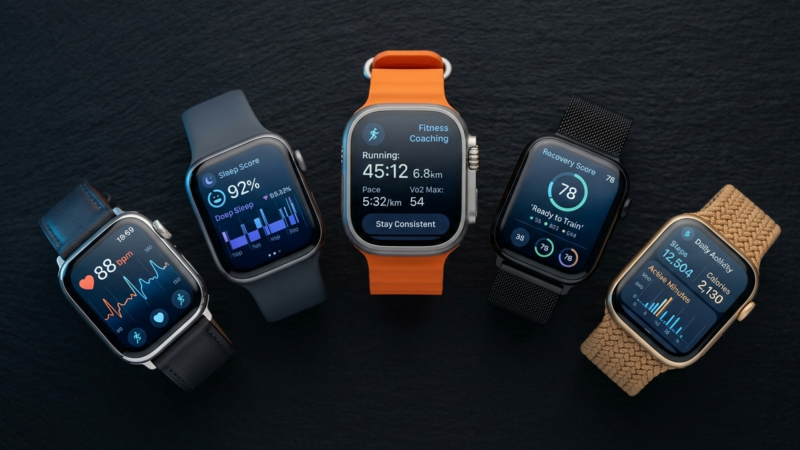
| Apple Watch Series 11 | AI Smartwatch | Apple Intelligence, ECG, health coaching, sleep insights | 18–36 hrs | $399–$799 |
| Samsung Galaxy Watch 8 | AI Smartwatch | Gemini AI, sleep apnea detection, AI fitness coaching | 40–96 hrs | $299–$499 |
| Oura Ring 4 | AI Smart Ring | Readiness Score, sleep staging, HRV, stress, body temp | 5–8 days | $349 + $5.99/mo |
| Plaud NotePin | AI Voice Wearable | Auto-transcription, meeting summaries, 300 min/mo free | Weeks | $149 |
| Bee AI Wearable | AI Ambient Pendant | Passive ambient memory, reminders, daily summaries | Full day | $49.99 |
The Best AI Wearables in 2026: Full Reviews
Meta Ray-Ban Smart Glasses Gen 3 — Best AI Smart Glasses for Everyday Use
If one device defines where AI wearables are heading in 2026, it is the Meta Ray-Ban Gen 3. These are the smart glasses that have finally cracked the hardest problem in wearable tech: making them look normal.
The biggest win for Meta in 2026 is that these glasses don’t look “techy.” Meta has managed to reduce weight by another 15%, making them comfortable enough for 12-hour wear. Slip them on and most people will not even notice you are wearing a computer on your face.
Under the hood, the enhanced Ray-Ban Meta Gen 2/3 glasses integrate the LLaMA 4 AI model for a seamless conversational experience with Meta AI, which you activate simply by saying “Hey Meta.” No need to unlock your phone — with a few words, the glasses make calls, send texts, control features, and find answers.
The real party trick is the camera’s AI vision. The glasses can now “see” what you see in real-time with zero lag. Whether you are looking at a menu in a foreign language or a broken engine part, you can ask “Hey Meta, what am I looking at?” and receive an instant audio explanation. Real-time translation in six languages pipes through the open-ear speakers, making international travel radically simpler.
The 12MP ultra-wide camera captures up to 3K video at 30fps, with a five-mic audio system for immersive recording. The redesigned charging case provides up to 8 additional charges beyond the 4–5 hours of standalone battery life.
Key AI Features:
- LLaMA 4 conversational AI via “Hey Meta” voice activation
- Real-time environmental vision and object recognition
- Live translation in 6+ languages
- Hands-free calling, texting, and social media livestreaming
- AI-powered photo and video capture
Pros:
- Looks identical to premium Ray-Ban eyewear
- One of the most natural AI assistant experiences available
- Available with prescription lenses and dozens of frame styles
- Strong photo/video quality for spontaneous capture
Cons:
- No heads-up display (see Display model for that)
- Privacy LED controversy continues; some regions restrict AI features
- Limited to Meta’s ecosystem for social sharing
Best for: Digital nomads, content creators, professionals who want hands-free AI without looking like a cyborg.
Meta Ray-Ban Display Glasses — Best for Contextual AR Computing
For those who want to take the smart glasses experience further, Meta’s Display version is a significant leap forward. The raison d’être of the Meta Ray-Ban Display glasses is to provide contextual information through an integrated 600×600 optical display and micro-projector that projects images and text onto the right lens.
The display delivers a 20-degree field of view at 42 pixels per degree, clocks at 90Hz, and ranges from 30 to 5,000 nits of brightness — with UV detection to automatically adjust. Content on the display is private, with less than 2% light leakage, meaning bystanders won’t see what you’re viewing.
The headline accessory is the Meta Neural Band. This wristband uses electromyography (EMG) to measure muscle activity from electrical signals based on your intended action — a wrist-based controller that operates invisibly. You can scroll, select, and navigate your display without touching anything or speaking.
At $799, these are a significant investment. But for power users who want the closest thing to a heads-up AI computer today, nothing else matches the package.
Best for: Early adopters, productivity-focused professionals, and developers building in the Meta ecosystem.
Apple Watch Series 11 — Best AI Smartwatch for iPhone Users
Apple has spent years quietly building what is now one of the most sophisticated health-tracking platforms ever put on a human wrist, and the Series 11 is where Apple Intelligence finally makes the watch feel like a true AI health companion.
The Apple Watch Series 11 offers a compelling combination of advanced health tracking, AI-based insights, and high-performance capabilities, including excellent sensors and intelligent coaching that connects easily with other devices.
On the health side, the watch now includes ECG on demand, AFib detection, blood oxygen monitoring, advanced sleep stage tracking, and crash detection. Heart health has gone clinical: ECG on demand, AFib detection, hypertension notifications, and now heart failure detection — all from a device on your wrist.
Apple Intelligence brings a new layer of proactive guidance, offering personalized coaching based on weeks of accumulated biometric data — not just telling you what happened, but explaining what it means and suggesting what to do next. The Siri integration means you can ask health questions and get contextual answers drawn from your actual body data.
Battery life sits at around 18 hours with always-on display, which remains a weakness, though Apple has continued to push improvements with power-efficient AI processing.
Key AI Features:
- Apple Intelligence health coaching and trend analysis
- ECG, AFib and sleep apnea detection
- Advanced crash and fall detection
- Siri with on-device AI and health context awareness
- Proactive Daily Summary and activity coaching
Pros:
- The gold standard for health tracking among smartwatches
- Deep iPhone and iPad ecosystem integration
- Mature app library and developer community
- On-device AI for privacy-focused processing
Cons:
- Requires daily charging
- Only useful if you are in the Apple ecosystem
- Premium pricing
Best for: iPhone users who want an all-in-one health monitor, smart assistant, and wrist computer.
Samsung Galaxy Watch 8 — Best AI Smartwatch for Android Users
Samsung’s Galaxy Watch 8 arrives as one of the most feature-complete Android smartwatches ever made, with a particular emphasis on AI-powered health coaching that genuinely competes with Apple.
The Samsung Galaxy Watch 8 is a major step forward for Android smartwatches. Among its applications is tracking of sleep stages, snoring detection, sleep apnea monitoring, and providing users with customized training programs via its AI-run coach.
What makes the Galaxy Watch 8 stand out in 2026 is the depth of its Gemini AI integration. Samsung has built dedicated Gemini AI action buttons for instant queries, and the watch’s sleep reports deliver data on sleep stages, movement, snoring, and sleep apnea detection, all with bedtime guidance.
Battery life is a genuine advantage over Apple — you can get 40 hours or more on a single charge in standard mode, and significantly longer in power-saving mode. The watch also supports blood pressure monitoring in supported regions, a feature Apple has yet to ship.
Key AI Features:
- Gemini AI integration with dedicated action button
- AI sleep coaching with snoring and apnea detection
- Personalized AI fitness coaching
- Energy score and readiness tracking
- ECG and blood pressure (select regions)
Pros:
- Excellent battery life versus Apple Watch
- Best Gemini AI integration of any smartwatch
- Rich health feature set at competitive pricing
- Works with any Android phone
Cons:
- Best features locked to Samsung Galaxy phone ecosystem
- Sleep coaching, while strong, still trails Oura Ring accuracy
Best for: Android users who want a premium AI health smartwatch without paying Apple prices.
Oura Ring 4 — Best AI Wearable for Health Monitoring
The Oura Ring 4 is the quiet overachiever of the AI wearables world. There is no screen. No notifications buzzing your finger. Just a titanium ring packed with sensors that knows your body better than most doctors see you in a year.
The Oura Ring 4 tracks heart rate, sleep stages, stress levels, body temperature, blood oxygen and more, with a battery life of up to 8 days and water resistance up to 100 meters. The sensors sit flush against your skin with no bumps, making it one of the most comfortable wearables you can own.
Where the Oura Ring 4 earns its reputation is in accuracy. In independent testing comparing the Oura Ring 4 to the Samsung Galaxy Ring and Apple Watch Series 11, the Oura Ring had the most accurate sleep data — the competition wasn’t wildly inaccurate, but couldn’t match Oura’s precision.
The AI engine behind the ring synthesizes all of this data into a daily Readiness Score — a single number from 1 to 100 that tells you how prepared your body is for the day ahead. The Readiness Score synthesizes sleep quality, recent activity, and recovery to inform daily decisions, making it perfect for anyone optimizing for peak performance.
New in the Oura Ring 4, the Automatic Activity Detection now includes average heart rate and heart rate zones for more than 40 different activities, giving a full overview of movement throughout the day.
Key AI Features:
- Daily Readiness Score (AI synthesis of sleep, HRV, temp, activity)
- Clinically accurate sleep stage analysis
- Heart rate variability (HRV) and stress monitoring
- Body temperature trending and illness detection
- AI-powered recovery and activity recommendations
Pros:
- Best-in-class sleep tracking accuracy
- Discreet, jewelry-like design you can wear 24/7
- Up to 8 days battery life
- Works with both iPhone and Android
Cons:
- No screen — all insights are app-based
- $5.99/month subscription for full feature access
- No GPS, so exercise tracking is limited
- Does not replace a smartwatch for notifications
Best for: Biohackers, health enthusiasts, people who hate wearing a watch to bed, and anyone who wants the deepest health data without the smartphone-on-the-wrist experience.
Plaud NotePin — Best AI Wearable for Productivity
The Plaud NotePin is a wearable AI note-taker that records conversations and automatically creates transcriptions, summaries, and insights for meetings, lectures, and clinical use cases, with a free plan offering 300 minutes of advanced transcription per month.
It clips to your clothing, collar, or any accessory and runs in the background, handling the administrative burden of note-taking so you can focus on the conversation itself. The AI engine doesn’t just transcribe — it pulls out action items, key decisions, and summaries that are organized and searchable.
Plaud devices have super long battery life, so you can wear them for days or even weeks without a recharge — a significant advantage over AI assistants that need nightly charging.
Best for: Professionals, journalists, consultants, students, and medical practitioners who live in meetings and need accurate documentation without lifting a finger.
Bee AI Wearable — Best Budget AI Wearable
Bee leads the affordable end of the AI wearables market at $49.99, offering a simple pendant that clips to clothing or wears like a fitness band. The device records everything it hears, learning your routines to create personalized reminders and notes. What sets Bee apart is its privacy-conscious mute button and the backing of Amazon, which acquired the startup.
Rather than requiring you to actively prompt it, Bee listens passively and builds a picture of your day — transforming ambient conversations and context into summaries, reminders, and memory prompts. It is the closest thing to a digital second brain you can buy for under $50.
The main caveat: constant recording raises real legal questions. In many jurisdictions, recording others without consent is illegal. Always check local recording laws before using ambient AI devices.
Best for: Curious early adopters, personal productivity enthusiasts, and anyone who wants to experiment with AI wearables without a major financial commitment.
Types of AI Wearables in 2026
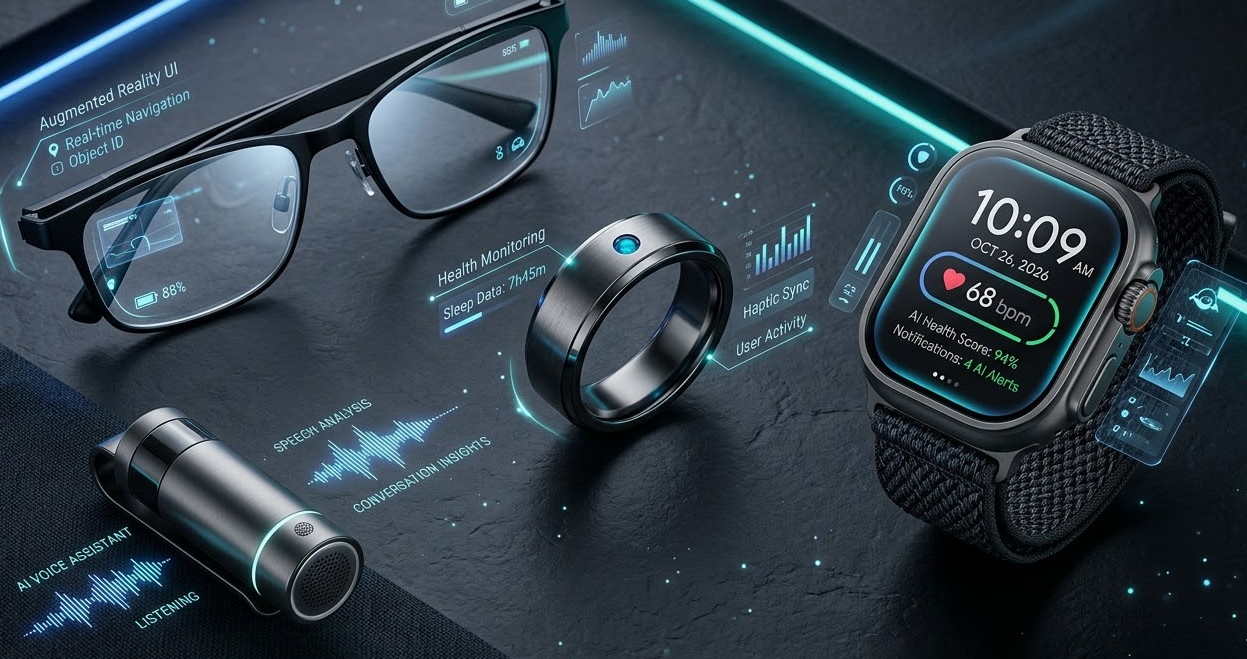
The AI wearables category has matured into several distinct types, each optimized for a different use case.
AI Smartwatches
The most familiar form factor, AI smartwatches put a capable computer on your wrist with a display, health sensors, and connectivity. Devices like the Apple Watch Series 11 and Samsung Galaxy Watch 8 are now running on-device AI models that provide real-time health coaching, predictive alerts, and proactive recommendations. On-device AI means your health data stays private — it never leaves your wrist.
AI Smart Glasses
The most exciting emerging category. Smart glasses replace the need to pull out your phone by bringing AI directly into your field of view — or into your ears via open-air speakers. AI glasses have matured beyond novelty into practical tools that keep you connected while keeping your hands free, with the best options balancing style with substance. The Meta Ray-Ban line leads the mainstream market, while the new Display version adds a heads-up screen for contextual computing.
AI Smart Rings
Discreet, jewelry-like devices that deliver clinical-grade health data without any screen. Ultra-thin smart rings prioritize comfort and adaptability, whether for sports, meetings, or a night out. The Oura Ring 4 remains the category leader, with Samsung’s Galaxy Ring offering a strong alternative for Android users.
AI Ambient/Voice Wearables
A newer category of clip-on or pendant devices focused on passive listening, transcription, and memory. Devices like the Plaud NotePin and Bee AI wear invisibly and focus on making the humans around you — and the conversations you have — permanently searchable and summarized.
AI-Powered Health Wearables
Purpose-built health trackers that go beyond step counting to deliver genuine medical-grade insights. In 2026, leading wearables offer clinical-grade ECG, SpO₂ readings, and even early-stage glucose monitoring, with sensor reliability rivaling dedicated medical equipment.
Key AI Features to Look For in 2026
AI Voice Assistants
The quality of the built-in voice assistant is the heart of any AI wearable experience. Look for assistants that work hands-free, understand natural language, and have access to context from your calendar, health data, and environment. Meta AI, Apple Siri with Apple Intelligence, and Google Gemini on Wear OS are the three most capable platforms in 2026.
Context-Aware Computing
The best AI wearables don’t just respond to commands — they understand where you are, what you’re doing, and what you likely need next. This is the shift from reactive AI (you ask, it answers) to proactive AI (it notices something and surfaces it before you ask).
Health Analytics and Predictive Insights
Adaptive AI algorithms that analyze behavioral patterns, sleep, and lifestyle cues deliver not just numbers, but precise, context-aware recommendations that evolve with users’ needs. Look for devices that go beyond raw data to offer coaching, predictions, and trend analysis over time.
Real-Time Translation
An increasingly important feature for international users and travelers. Timekettle’s W4 buds use AI Bone-Conduction Pickup to capture vibrations directly from the vocal cords, solving the problem of ambient noise during real-time translation — paired with a new SOTA Engine Selector that automatically picks the best translation engine for each language pair.
Privacy and Data Protection
This matters more than ever as wearables accumulate deeply personal data. Prioritize devices with on-device AI processing, transparent data policies, hardware privacy switches (mute buttons, LED indicators), and clear data deletion options. The best devices include visual indicators when recording and hardware privacy switches, demonstrating that privacy and functionality can coexist.
Battery Life
Leading wearables in 2026 promise a full week or more on a single charge, even with intensive health monitoring enabled, enabled by smart battery management and AI-driven sensor scheduling. Poor battery life remains the single biggest friction point in AI wearable adoption.
Best AI Wearables by Category
Best AI Wearable for Productivity
Winner: Plaud NotePin No other device does more for your professional output with less friction. Clip it on, forget it’s there, and come out of every meeting with a structured, searchable transcript and action items already sorted.
Best AI Wearable for Health Monitoring
Winner: Oura Ring 4 Best-in-class sleep tracking, the most accurate Readiness Score in the market, and clinical-level sensor data — all in a ring you can wear to bed, in the shower, and to a board meeting without anyone noticing.
Best AI Wearable for Everyday Use
Winner: Meta Ray-Ban Smart Glasses Gen 3 The most seamless AI assistant experience in 2026. Hands-free, always available, and — critically — not embarrassing to wear in public.
Best AI Smart Glasses
Winner: Meta Ray-Ban Display Glasses For those who want actual heads-up contextual computing today, the Display model’s 600×600 HUD with Neural Band control is the most sophisticated consumer smart glasses experience available.
Best AI Smartwatch
Winner: Apple Watch Series 11 (iPhone users) / Samsung Galaxy Watch 8 (Android users) Each is the undisputed leader in their respective ecosystem. iPhone users get Apple Intelligence and the deepest health integration. Android users get Gemini AI, longer battery, and blood pressure monitoring.
Humane AI Pin vs. Rabbit R1: Where Are They Now?
When these two devices launched in 2024, they were the most-hyped AI wearables on the market. By 2026, the picture is more sobering — and instructive.
The Humane AI Pin launched as a laser-projected AI assistant you wear on your chest. While the concept was genuinely innovative, the execution struggled with slow response times, heat issues, and a subscription model that was difficult to justify alongside existing smartphones. Humane went through significant restructuring, and as of 2026 the Pin has been largely superseded by the more polished smart glasses category. The AI Pin remains an important milestone in the history of screenless computing — but it is not the device most people should be buying in 2026.
The Rabbit R1 launched as a handheld AI assistant rather than a true wearable. Recent software updates addressed initial performance issues and introduced “Creations,” allowing users to build custom tools and games. The R1 has found a niche as a phone companion for users who want a dedicated AI device — but it competes directly with smartphones in a way that makes its value proposition harder to defend as AI is baked into smartwatches and glasses.
The verdict: Both products revealed that hardware design matters as much as AI capability, and that any device requiring users to change their behavior dramatically faces an uphill battle. The lesson has been absorbed by every manufacturer that followed them.
FAQ: Everything You Need to Know About AI Wearables
What are AI wearables?
AI wearables are physical devices you wear on your body — on your wrist, face, finger, or clothing — that incorporate artificial intelligence to understand context, assist with tasks, monitor your health, or interact with your environment in real time. They go beyond passive tracking to actively interpret data and take intelligent action.
How do AI wearables work?
AI wearables use a combination of sensors (cameras, microphones, accelerometers, biometric sensors) to collect data, then process it either on the device itself (on-device AI) or in the cloud. Machine learning models interpret the data to provide insights, answer questions, translate language, or trigger actions. The best 2026 devices use dedicated NPU chips to run these models directly on the hardware for speed and privacy.
Are AI wearables the future of smartphones?
They are emerging as a complement to smartphones rather than an immediate replacement. By the end of 2026, the way we think about recording our lives and interacting with AI will look very different, with smart glasses with AI assistants and professional body cameras with real-time streaming converging toward a future where technology becomes invisible. The smartphone is not going away soon — but the amount of time you spend looking at it is beginning to decrease.
Which AI wearable is the most useful in 2026?
For most people, the Meta Ray-Ban Smart Glasses Gen 3 offers the best balance of AI utility, everyday wearability, and value. For health-focused users, the Oura Ring 4 delivers unmatched insights. For professionals, the Plaud NotePin is transformative for anyone who lives in meetings.
Are AI wearable devices safe to use?
The hardware is safe to wear for the vast majority of users. The more important safety considerations are around data privacy, consent in recording scenarios, and the psychological impact of constant AI mediation. Always use devices with hardware privacy switches, review data retention policies carefully, and be aware of local laws regarding the recording of other people.
Do AI wearables need a subscription?
It depends on the device. The Oura Ring 4 requires a $5.99/month subscription for full AI features. Smart glasses from Meta tie into Meta AI, which is currently included. Apple Watch AI features are bundled with Apple Intelligence at no extra charge. Plaud NotePin includes 300 free minutes of transcription per month with optional paid tiers.
The Future of AI Wearables: What’s Coming Next
On-Device AI Goes Mainstream
The Snapdragon Wear Elite chip’s 5x jump in CPU performance and 30% better battery efficiency will define the smart in every major 2027 flagship, enabling billion-parameter AI models to run on-device in watches, pins, and pendants. By 2027, on-device AI will be the norm, not the exception.
AI Glasses Replace More Smartphone Functions
The trajectory is clear: smart glasses with display overlays are the most viable candidate for reducing smartphone screen time. As displays improve, battery life extends, and form factors slim down, glasses will absorb more and more of what we currently do on our phones — navigation, messaging, quick searches, translation, payments.
Health Prediction, Not Just Monitoring
Wearables are now serious tools for chronic condition management, stress reduction, remote patient monitoring, and early disease detection, with AI integrating input from miniaturized sensors tracking heart rate variability, respiration, blood oxygen levels, and more. The next frontier is moving from monitoring to prediction — your wearable alerting you to an oncoming illness or stress event before you feel it.
Android XR and the Multi-Platform Smart Glasses War
The combination of Google’s AI expertise, Samsung’s hardware prowess, and the openness of the Android XR platform makes upcoming smart glasses from that collaboration one of the most anticipated launches of the coming year. Apple is rumored to be developing its own AI glasses, and the resulting competition will accelerate the entire category.
Ambient AI Becomes Standard
The shift from reactive AI (you ask, it responds) to ambient AI (it understands your context continuously and acts proactively) is already underway with devices like Bee and Plaud. Expect this capability to be integrated into mainstream smartwatches and glasses over the next two years.
Final Verdict: Which AI Wearable Should You Buy?
The AI wearables market in 2026 is wide, varied, and genuinely exciting — but it is also easy to overspend on the wrong device for your needs. Here is the straightforward breakdown:
Buy the Meta Ray-Ban Gen 3 ($329+) if you want a hands-free AI assistant that you will actually wear every day. The combination of LLaMA 4 AI, real-time translation, camera vision, and premium eyewear design makes this the most accessible and genuinely useful AI wearable for most people in 2026.
Buy the Oura Ring 4 ($349) if health monitoring is your priority and you want the most accurate sleep and recovery data available in a discreet, low-friction form factor. It is the single best device for understanding your body.
Buy the Apple Watch Series 11 ($399+) if you are an iPhone user who wants an all-in-one smart assistant, health tracker, and communication device. The AI integration is mature, the health monitoring is clinical-grade, and the app ecosystem is unmatched.
Buy the Samsung Galaxy Watch 8 ($299+) if you are on Android and want the Apple Watch experience with better battery life and Gemini AI.
Buy the Plaud NotePin ($149) if you are a professional who spends significant time in meetings and wants AI-powered transcription and summaries with no friction.
Buy the Bee AI ($49.99) if you want to experiment with ambient AI at minimal cost and risk.
The most important thing to understand about AI wearables in 2026 is that this category is still in its early chapters. The devices available today are genuinely useful — but the ones shipping in 2027 and 2028 will be dramatically better. If you are on the fence, the best entry point is one that fits naturally into your existing life. The device you actually wear every day will always outperform the impressive one sitting on a charger.
More from TekX.io: